In an automated packaging production line, a seemingly simple yet crucial step is often overlooked: how to transform the chaotic and disordered materials at the end of the production line into an "orderly queue" with neat arrangement, consistent spacing, and uniform orientation, and stably feed them into the packaging machine. This "from disorder to order" transformation is the core mission of the automatic material unscrambler.
Hanlee Automation Technology Co., Ltd.
If the packaging machine is compared to the "heart" of the production line, then the unscrambler is the "blood vessel" that ensures smooth blood flow. Once the unscrambling equipment fails, the phase or speed of the materials fed to the packaging machine will deviate, causing equipment jams or empty packages, seriously affecting normal production. As a key link connecting upstream production and downstream packaging, the automatic material unscrambler is playing an irreplaceable role in many industries such as food, pharmaceuticals, daily chemicals, and electronics.
II. Working Principle and Core Functions
The essence of an automatic material unscrambler is a "material ordering system." Its basic working logic can be summarized in four steps: separation, adjustment, arrangement, and conveying.
After materials enter the unscrambler in a scattered state, they first undergo gradual processing through multiple conveyor belts. Taking a typical four-stage unscrambler as an example: the first two stages are responsible for "tightening" the materials—detecting material distribution through level sensors. When material accumulation is detected, the conveyor belt automatically slows down, allowing materials to gradually increase spacing; the third stage is responsible for "filling up," arranging materials into a continuous queue; the fourth stage achieves "phase adjustment," evenly spacing materials to a specific phase and precisely feeding them into the packaging machine.
This multi-stage design is not redundant, but rather a respect for material characteristics. If materials are tightened too aggressively, they may slip on the conveyor belt, disrupting the arrangement order. Dividing the process into multiple stages for gradual tightening can effectively avoid this problem.
In more complex application scenarios, the unscrambler also needs to solve the problem of material "orientation." For example, after sterilization treatment, soft-packaged food bags may enter subsequent processes in any orientation. The random material unscrambler uses high-precision sensors to identify the online morphology of materials in real time, and cooperates with servo systems to achieve automatic material turning and same-side arrangement, so that all materials enter downstream cartoning or boxing links with a uniform orientation.
III. Equipment Structure and Key Technologies
3.1 Main Structure: Modular Multi-Stage Conveying System
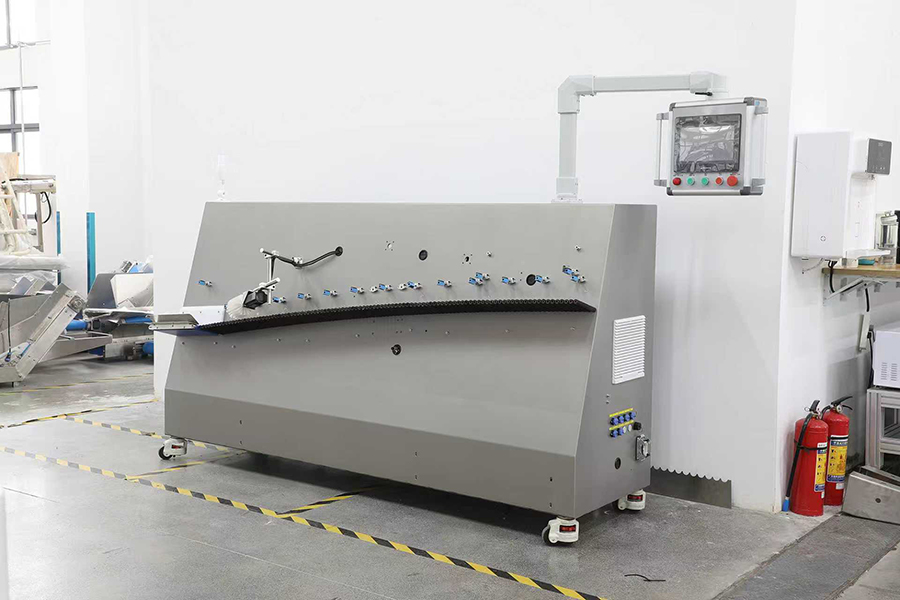
An automatic material unscrambler is usually composed of multiple functional modules. Taking the Hanlee Automation Technology Co., Ltd. automatic material unscrambling line solution as an example, the typical equipment structure includes:
Feeding section: connects to the upstream production line or manual loading, receiving materials to be unscrambled;
Multi-stage conveyor belts: driven by frequency converters or servo motors, completing material spacing adjustment and queue arrangement;
Detection system: sensors (such as laser sensors, photoelectric sensors) are arranged at key positions to monitor material position and status in real time;
Control unit: PLC calculates and adjusts the speed of each section based on detection signals to achieve precise synchronization;
Discharge section: conveys the arranged materials to the packaging machine at a fixed phase.
3.2 Servo Synchronization: The Core of Precision Assurance
The synchronization precision between the unscrambler and the packaging machine directly affects packaging quality and equipment stability. In traditional solutions, each section of the unscrambling line is driven by frequency converters. Although this meets basic needs, it falls short in occasions requiring high dynamic performance—especially when the final discharge section needs to adjust speed in real time according to the packaging machine spindle signal.
Modern solutions use pulse-type electronic cam technology, where the unscrambling line and packaging machine achieve position synchronization following, with small synchronization error and fast response speed, significantly improving feeding precision and packaging yield. The controller calculates the electronic gear ratio in real time according to the packaging machine speed, and switches at high speed through sensor signals to achieve precise adjustment of speed or phase.
3.3 Multi-Channel Design: Breaking the Efficiency Bottleneck
In packaging scenarios of "one bag with multiple materials" (for example, each bag needs to contain two or more materials), a single-channel unscrambler faces a natural bottleneck: the material source feeding efficiency is fixed. If each bag requires x materials, the production efficiency is 1/x of the feeding efficiency.
The multi-channel automatic material unscrambling system adds two or more independent feeding channels, each equipped with an independent material source, multiplying the unscrambling efficiency. Materials from each channel merge at the feeding convergence machine, forming a stacked or side-by-side state before being fed into the packaging link. This design effectively offsets the efficiency loss caused by "one bag with multiple materials."
To solve the "non-synchronization" problem caused by feeding speed differences between multiple channels, the multi-stage unscrambling conveying mechanism achieves fine adjustment of material positions in each channel through multiple variable-speed conveyor belts and detection devices, ensuring that materials can arrive at the convergence point synchronously.
3.4 Intelligent Recognition and Rejection: Moving Quality Control Forward
High-end random material unscramblers integrate more intelligent functions. The equipment can determine material accumulation on the conveyor belt through laser sensors, automatically control the start and stop of upstream silo feeding, and avoid material congestion. At the end roller, the system can automatically reject non-conforming products such as overlapping packages and connected packages, ensuring that only qualified materials with uniform spacing enter the downstream packaging link.
Some equipment also supports extended functions such as QR code reading, weight detection, and counting, making the unscrambler not only an "order organizer" but also a front-line checkpoint for quality inspection.
Hanlee Automation Technology Co., Ltd.
IV. Application Fields and Industry Value
4.1 Main Application Scenarios
The most representative application fields of automatic material unscramblers include:
Food industry: automatic packaging feeding for sachima, biscuits, baked goods, snacks, etc. Post-processing of soft-packaged foods (vacuum packaging, nitrogen-flushed packaging) is a typical scenario for unscramblers, including tea bags, coffee bags, hot pot seasonings, pickled vegetables, etc.
Pharmaceutical industry: pre-cartoning and pre-bagging arrangement and counting of soft-packaged drugs (powders, granules, liquids).
Daily chemicals and hardware: conveying, aligning, and sorting of square, round, and strip-shaped products. Automatic can unscramblers play an important role in the arrangement and directional conveying of metal cans, plastic cans, glass bottles, and other containers.
Electronics manufacturing: automatic parts feeders are widely used in material supply links in consumer electronics, semiconductors, and other fields.
4.2 Industry Value
The core value of automatic material unscramblers is reflected in three dimensions:
Efficiency improvement: automated unscrambling replaces manual sorting and arrangement. Unscrambling speed can reach over 200 bags per minute, and multi-channel solutions can further break through single-channel efficiency bottlenecks.
Quality assurance: through precise spacing control and phase synchronization, packaging defects such as empty bags and jammed bags are reduced; non-conforming products are automatically rejected, preventing problematic materials from entering the packaging link.
Labor replacement: the entire line operates fully automatically without manual intervention, solving the labor shortage problem in labor-intensive industries such as food and daily chemicals against the backdrop of rising labor costs.
V. Development Trends
5.1 Intelligent Upgrade: From "Execution" to "Perception-Decision"
Currently, unscramblers are still mainly based on "executing preset logic." In the future, they will evolve toward intelligent agents of "perception-decision-execution." The application of machine vision technology will enable equipment to identify material types, postures, and defects, achieving adaptive adjustment. Combined with industrial internet platforms, unscrambling equipment will support functions such as visualization of operating status, anomaly warning, and process optimization.
5.2 Flexibility and Modularization
The production model of small batches and multiple varieties places higher demands on equipment changeover efficiency. In the future, unscramblers will develop toward modular design—enterprises can flexibly combine functional modules according to production needs, quickly switch production line configurations, and reduce equipment investment costs. Problems such as poor adaptability to irregular materials and complex changeover adjustments are becoming key directions for industry technological breakthroughs.
5.3 Service Model Innovation
Equipment manufacturers are transforming from "selling equipment" to "providing overall solutions." New service models such as equipment leasing, pay-per-use, and remote operation and maintenance are emerging. For equipment such as unscramblers that are deeply coupled with overall line efficiency, full life-cycle service capabilities will become a key dimension of competition.
Although the automatic material unscrambler is not as "eye-catching" as coating machines or winding machines, it plays a key connecting role from "manufacturing" to "packaging" in the automated production chain. From the simplest multi-stage conveying and arranging to intelligent unscrambling systems integrating servo synchronization, visual recognition, and multi-channel coordination, the technological evolution of this equipment is a microcosm of the continuously improving automation level of the food and packaging industry.
In the future, with the deepening of intelligent manufacturing and flexible production, the automatic material unscrambler will continue to evolve from an "auxiliary equipment" to an "efficiency engine," providing more efficient and intelligent underlying support for automated packaging in various industries.




 中文版
中文版







 Location: