In today's continuous upgrading of automated packaging production lines, enterprises have increasingly high requirements for efficiency, stability, and labor cost control. The combination of an unordered material sorting machine and a cartoning machine is becoming the most mainstream and efficient configuration for stick packs, soft pouches, and small boxed products. This linked system not only solves the problems of slow, error-prone, and unstable traditional manual material sorting, but also enables the entire packaging line to truly achieve "messy feeding, orderly output, and fast cartoning," directly doubling production efficiency.
In the past, most enterprises relied on manual labor to complete material sorting, counting, and box placement. Workers had to align disordered stick packs one by one, count them accurately, and then manually feed them into the cartoning machine. This model was not only slow and labor-intensive, but also prone to problems such as inaccurate counting, wrinkled pouches, and inconsistent box placement orientations. During peak order seasons, manual labor could not keep up with production capacity, and overtime, missed loading, and incorrect loading occurred frequently, directly affecting delivery speed and product quality.
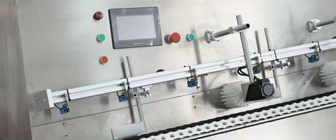
Pairing an unordered material sorting machine with a cartoning machine changes this situation from the source. The unordered material sorting machine is responsible for "front-end sorting." It can directly receive scattered, stacked, and inconsistently oriented materials. Through flexible breaking up, posture correction, and directional conveying, it quickly arranges disordered stick packs into a stable flow with uniform orientation and even spacing. The entire process requires no manual alignment and no frequent feeding, truly achieving unmanned material sorting.
The sorted materials are then accurately and smoothly fed into the cartoning machine. The cartoning machine is responsible for "back-end forming," automatically opening boxes, loading materials, and sealing boxes in one continuous process. After the two are linked, the production line is no longer limited by manual speed. Production capacity becomes stable, continuous, and controllable, and the failure rate drops significantly. Compared with a purely manual model, the efficiency of this combined line can increase by more than 100%, truly "doubling production efficiency."
This combination performs particularly well in scenarios such as probiotic powder stick packs, dietary fiber stick packs, meal replacement stick packs, facial mask pouches, sample pouches, medicine blister cards, and small daily chemical packages. Soft pouch materials are prone to sticking, wrinkling, and stacking, making manual handling difficult. However, the unordered material sorting machine uses a flexible structure that does not damage pouches or cause material jams. Combined with the cartoning machine's precise counting, it ensures that each box contains a consistent quantity and has a neat appearance.
At the same time, the linked production line greatly reduces manual input. The material sorting, counting, and box placement work that originally required 3–5 people can now be completed with only 1 person monitoring the equipment. Enterprises not only save substantial labor costs, but also reduce training costs and management pressure caused by personnel turnover, making production more stable and safer.
From the perspective of long-term enterprise development, the combination of an unordered material sorting machine and a cartoning machine is an extremely cost-effective automation upgrade solution. It occupies little space, is easy to integrate into existing production lines, and is simple to switch between specifications. It adapts to multi-category and multi-batch production, meeting current production increase needs while also responding to future capacity expansion.
Under the manufacturing trend of pursuing high efficiency, intelligence, and stability, an unordered material sorting machine paired with a cartoning machine has become a standard choice for enterprises to improve quality and efficiency. With less time, fewer workers, and higher quality, it truly doubles packaging capacity and creates sustained and considerable benefits for enterprises.




 中文版
中文版







 Location: