In industries such as food, the large health industry, coffee, pet snacks, and daily chemicals, back-end packaging has always been a key stage affecting production capacity, quality, and cost. Many enterprises' packaging lines appear to be fully equipped, yet they are often held back by various "small problems": disordered materials, slow manual material sorting, frequent machine jamming, inaccurate counting, and high losses from pouch breakage. These seemingly minor packaging pain points have long slowed production efficiency and increased operating costs. The emergence of unordered material sorting machines is precisely aimed at solving these pain points, turning the packaging stage from a "bottleneck" into a "highlight."
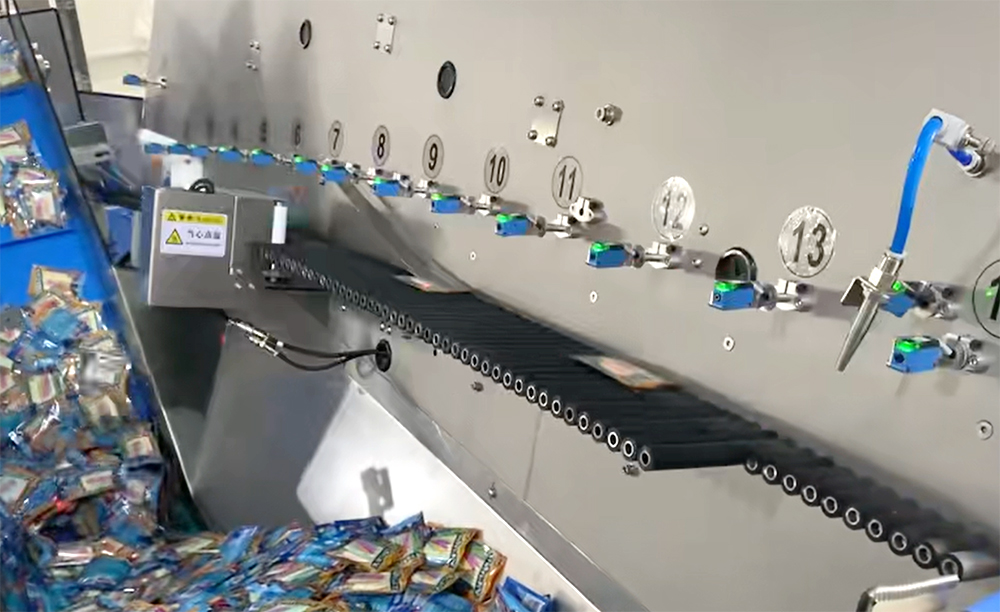
The most common pain point in traditional packaging is that materials are disordered and difficult to organize. For soft pouch products such as coffee sticks, probiotic powder stick packs, cat treat sticks, facial mask pouches, and meal replacement sticks, the pouches are light, thin, prone to wrinkling, and prone to sticking together. After discharge, they face inconsistent directions and are piled up in disorder. If they directly enter the cartoning machine, they can easily cause material jamming, stacked packs, and disordered postures, leading to frequent equipment downtime. Manual material sorting is not only slow but also affected by worker conditions, making it impossible to keep up with order demand during peak seasons. Unordered material sorting machines can directly receive scattered materials, automatically break them up, correct them, and sequence them, turning disordered incoming materials into a neat and stable material flow and solving the material sorting challenge at the source.
High labor costs and low efficiency are another major packaging pain point. Many enterprises rely on manual counting, material placement, and box loading. A single line requires three to five people to work together, keeping wages, management, and training costs high. Manual operation is also prone to fatigue and distraction, leading to problems such as overloading, underloading, and incorrect orientation. Unordered material sorting machines achieve automated material sorting, precise counting, and stable conveying. One machine can replace multiple workers, greatly reducing labor input and enabling packaging lines to operate with fewer staff or even unattended, with efficiency more than double that of manual work.
Material damage and high loss also give enterprises headaches. During manual rubbing, squeezing, and friction, soft pouch packaging is prone to scratching, powder leakage, and deformation, directly causing raw material waste and product downgrading. Unordered material sorting machines use a flexible material sorting structure. The contact parts are smooth and free of burrs, and the conveying process is gentle without squeezing, effectively protecting the integrity of packaging pouches, significantly reducing the pouch breakage rate, and improving the good product rate.
Unstable packaging and inconsistent quality also affect brand image. Inconsistent manual operation standards lead to uneven quantities, appearances, and arrangements in each box, greatly diminishing the product image before shipment. Unordered material sorting machines work with precise counting and stable discharging to ensure that each box has an accurate quantity, neat arrangement, and consistent appearance, achieving packaging standardization and enhancing product competitiveness.
In addition, traditional packaging lines are troublesome to change over and take a long time to debug, making it difficult to adapt to the market demand for multiple categories and small batches. Unordered material sorting machines support quick adjustment of gaps, speed, and guides. Switching product specifications is simple and fast, and the degree of flexibility is high, allowing enterprises to easily handle diversified production.
It can be said that an unordered material sorting machine is not an "optional device," but "essential equipment" for solving packaging pain points. It specifically addresses a series of back-end packaging challenges such as disordered materials, tired workers, frequent machine jamming, high losses, and poor quality, making packaging lines smoother, more efficient, more stable, and more cost-effective.
In today's industry-wide automation upgrade, whoever solves packaging pain points first can gain an edge in efficiency and cost. With mature and reliable solutions, unordered material sorting machines help enterprises open up the last mile of production, ensuring that packaging no longer holds them back and truly achieving quality improvement, efficiency enhancement, cost reduction, and quality stability.




 中文版
中文版







 Location: